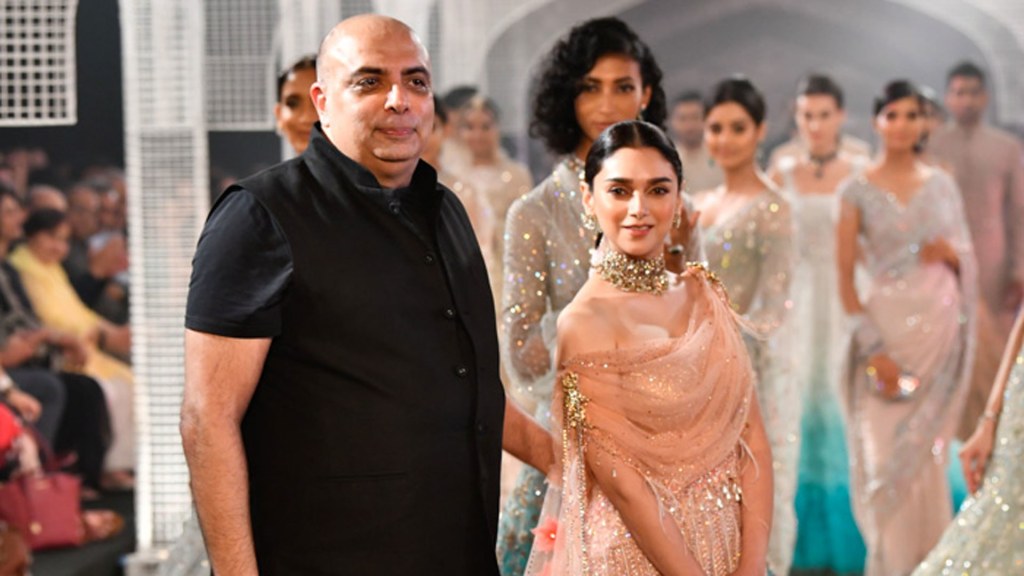
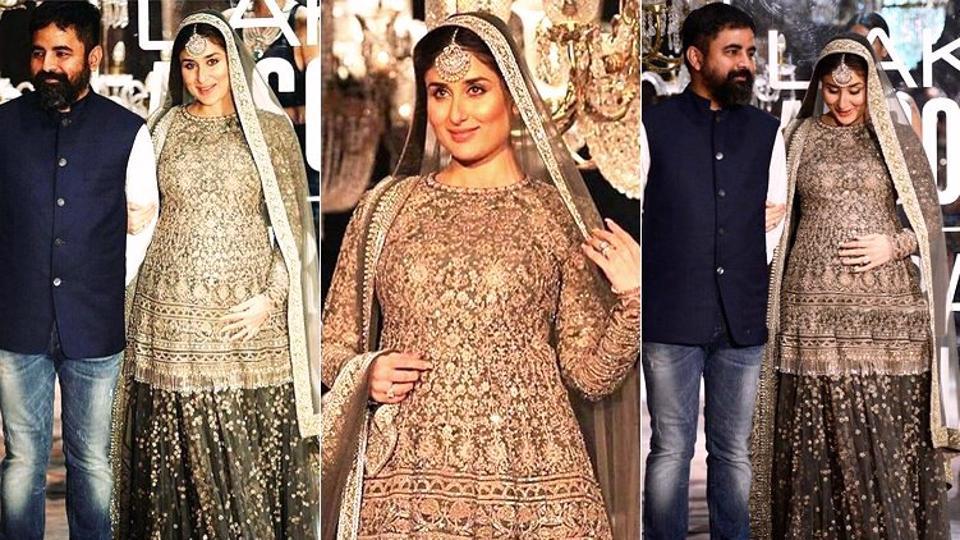
Tarun Tahiliani is a noted Indianfashion designer.[1][2][3] With his wife Sailaja ‘Sal’ Tahiliani, he co-founded Ensemble, India’s first multi-designer boutique in 1987, followed by Tahiliani Design studio in 1990. Based in Delhi, he is best known for his ability to infuse Indian craftsmanship and textile heritage with tailored silhouette.[4] His signature is to combine traditional aesthetics with modern design. Over the years, he also became known for his bridalwear.[5]
Of late, Tahiliani has taken on several projects in interior design. He has designed interiors for hotels (such as The Sofala, Goa),[6] restaurants (the Aish at the Park, Hyderabad),[7] resorts and homes, and has even begun to event design for Indian weddings.
Early life and family
Tahiliani was born and brought up in Mumbai in extended Sindhi family. His father Admiral R H Tahiliani, was with the Indian Navy, thus his family including sister Tina Tahiliani were posted to various locations in India.[8] After studying initially at Campion School, Mumbai,[8] then during his teenage, his father was posted to Delhi, then he went to study at The Doon School, a boarding school in Dehradun, passing out in 1980. After his schooling he joined St. Stephen’s College in Delhi as an honours student. However, not finding it challenging enough, he left it after a year and then went on US, where he studied at Vassar College, New York for one year,[8] and went on to obtain a degree in Business Management from the Wharton Business School, University of Pennsylvania.[9][10]
His father, later served as the Chief of the Naval Staff of the Indian Navy between 1984 and 1987 and as the Governor of Sikkim between 1990 and 1994. His mother Jaswanti Tahiliani was the first female engineer in Mumbai, who studied at VJTI, Mumbai.[11] She died of cancer, while he was still studying at Doon School, a few years later his father remarried to Meera.[8]
While studying in US, through a common friend, he met Sailaja (Sal), an economics student at the University of Pennsylvania, and his future wife. They married soon after his return to India in 1980. Sal, who was brought up in New York, had a short modelling career wherein she even modelled for Pierre Cardin, before heading Tahiliani retail operations. The couple have two sons.[8][12]
Career
On returning to India, he first joined the family business in oil-field equipments.[11] Eventually, in 1987 he and Sailaja opened the first multi-designer boutique in India, ‘Ensemble’ with help of designer Rohit Khosla in Mumbai. The stored featured works of five designers Abu Jani & Sandeep Khosla, Rohit Khosla, Anuradha Mafatlal, American fashion designer Neil Bieff and label Anaya, by Anita Shivdasani and Sunita Kapoor, Anil Kapoor’s wife and their own label, Ahilian.[13][14][15] By now, he had started sketching however he was still untrained a designer, thus in 1991, he went to Fashion Institute of Technology (FIT) in New York to study designing. After his return he shifted business to Delhi. When in 1995, British heiress Jemima Khan wore one of his outfit for her wedding to Imran Khan, his work was first noticed.[8][13]
Today, after over 25 years, Ensemble has stores both in Mumbai and Delhi, and Tahiliani runs the chain with his sister Tina Tahiliani Parikh, who joined the business in 1990.[16][17]
Tarun also worked with Save the Children India to urge the government to increase the health budget to 3 per cent ahead of the budget announcement
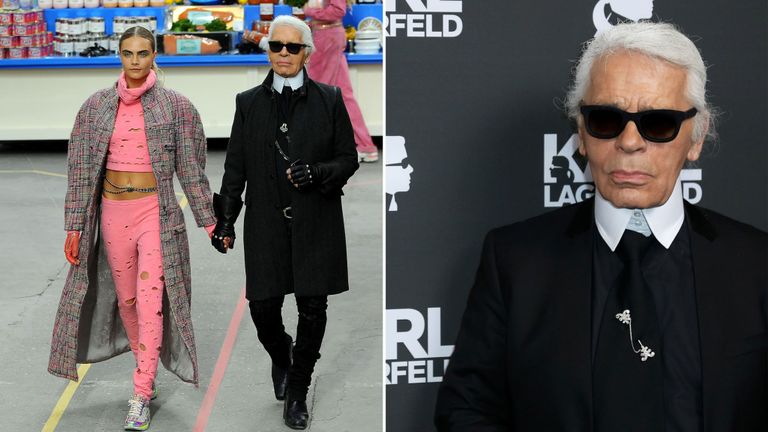
Karl Otto Lagerfeld (German: [kaʁl ˈlaːɡɐˌfɛlt] (listen); 10 September 1933 – 19 February 2019) was a German creative director, fashion designer, artist, photographer, and caricaturist who lived in Paris.[7][8]
He was known as the creative director of the French fashion house Chanel, a position held from 1983 until his death, and was also creative director of the Italian fur and leather goods fashion house Fendi, and of his own eponymous fashion label. He collaborated on a variety of fashion and art-related projects.
Lagerfeld was recognized for his signature white hair, black sunglasses, fingerless gloves, and high, starched, detachable collars.
Early life
Lagerfeld was born on 10 September 1933 in Hamburg, to Elisabeth (née Bahlmann) and businessman Otto Lagerfeld.[9] His father owned a company that produced and imported evaporated milk; while his maternal grandfather, Karl Bahlmann, was a local politician for the Catholic Centre Party.[9] His family belonged to the Old Catholic Church. When Lagerfeld’s mother met his father, she was a lingerie saleswoman from Berlin. His parents married in 1930.[10]
Lagerfeld was known to misrepresent his birth year, claiming to be younger than his actual age, and to misrepresent his parents’ background. For example, he claimed that he was born in 1938 to “Elisabeth of Germany” and Otto Ludwig Lagerfeldt from Sweden.[11] These claims have been conclusively proven to be false, as his father was from Hamburg and spent his entire life in Germany, with no Swedish connection.[9][10] There is also no evidence that his mother Elisabeth Bahlmann, the daughter of a middle-class local politician, called herself “Elisabeth of Germany”.[10] He was known to insist that no one knows his real birth date. In an interview on French television in February 2009, Lagerfeld said that he was “born neither in 1933 nor 1938”.[12]
In April 2013, he finally declared that he was born in 1935.[13] A birth announcement was, however, published by his parents in 1933, and the baptismal register in Hamburg also lists him as born in that year, showing that he was born on 10 September 1933.[14]Bild am Sonntag published his baptismal records in 2008 and interviewed his teacher and a classmate, who both confirmed that he was born in 1933. The same was later confirmed by his death record.[15] Despite that, Karl Lagerfeld announced publicly that he was celebrating his “70th birthday” on 10 September 2008, despite actually turning 75.[16][17][18]
His older sister, Martha Christiane “Christel”, was born in 1931. Lagerfeld had an older half-sister, Thea, from his father’s first marriage. His family name has been spelled both Lagerfeldt (with a “t”) and Lagerfeld. Like his father, he used the spelling Lagerfeld, considering it to “sound more commercial”.[19]
His family was mainly shielded from the deprivations of World War II due to his father’s business interests in Germany through the firm Glücksklee-Milch GmbH.[20][21] His father had been in San Francisco during the 1906 earthquake.[22]
As a child, he showed great interest in visual arts, and former schoolmates recalled that he was always making sketches “no matter what we were doing in class”.[23] Lagerfeld told interviewers that he learned much more by constantly visiting the Kunsthalle Hamburg museum than he ever did in school.[24] His greatest inspiration came from French artists, and he claimed to have only continued school in order to learn the French language so that he could move there.[24] Lagerfeld finished his secondary school at the Lycée Montaigne in Paris, where he majored in drawing and history.[25]
Career
Early career and Fendi (1955–1982)
In 1955, after living in Paris for two years, Lagerfeld entered a coat design competition sponsored by the International Wool Secretariat. He won the coat category and befriended Yves Saint Laurent, who won the dress category, and was soon after hired by Pierre Balmain. He worked as Balmain’s assistant, and later apprentice, for three years.[26][27]
In 1958, Lagerfeld became the artistic director for Jean Patou. In 1964, he went to Rome to study art history and work for Tiziano but was soon designing freelance for a multitude of brands, including Charles Jourdan, Chloé, Krizia, and Valentino.[28]
In 1967, he was hired by Fendi to modernize their fur line. Lagerfeld’s innovative designs proved groundbreaking, as he introduced the use of mole, rabbit, and squirrel pelts into high fashion. Lagerfeld remained with Fendi until his death.
nternational fame with Chanel (1982–2000)
In the 1980s, Lagerfeld was hired by Chanel, which was considered a “near-dead brand” at the time since the death of designer Coco Chanel a decade prior. Lagerfeld brought life back into the company, making it a huge success by revamping its ready-to-wear fashion line.[3][26] Lagerfeld integrated the interlocked “CC” monograph of Coco Chanel into a style pattern for the House of Chanel.[28][29]
In 1984, a year after his start at Chanel, Lagerfeld began his own eponymous “Karl Lagerfeld” brand. The brand was established to channel “intellectual sexiness”.[3]
In 1993, US Vogue editor-in-chief Anna Wintour walked out of his Milan Fashion Week runway show, when he employed strippers and adult-film star Moana Pozzi to model his black-and-white collection for Fendi.[30]
Later career (2001–2019)
Fashion
In 2002, Lagerfeld asked Renzo Rosso, the founder of Diesel, to collaborate with him on a special denim collection for the Lagerfeld Gallery.[31] The collection, Lagerfeld Gallery by Diesel, was co-designed by Lagerfeld and then developed by Diesel’s creative team, under the supervision of Rosso. It consisted of five pieces that were presented during the designer’s catwalk shows during Paris Fashion Week[32] and then sold in highly limited editions at the Lagerfeld Galleries in Paris and Monaco and at the Diesel Denim Galleries in New York and Tokyo. During the first week of sales in New York, more than 90% of the trousers were sold out, even though prices ranged from $240 to $1,840.[33] In a statement after the show in Paris, Rosso said: “I am honored to have met this fashion icon of our time. Karl represents creativity, tradition and challenge, and the fact that he thought of Diesel for this collaboration is a great gift and acknowledgement of our reputation as the prêt-à-porter of casual wear”.[32]
In December 2006, Lagerfeld announced the launch of a new collection for men and women dubbed K Karl Lagerfeld, which included fitted T-shirts and a wide range of jeans.[34] In September 2010, the Couture Council of The Museum at the Fashion Institute of Technology presented Lagerfeld with an award created for him, The Couture Council Fashion Visionary Award, at a benefit luncheon at Avery Fisher Hall, in New York City.[35] In November 2010, Lagerfeld and Swedish crystal manufacturer Orrefors announced a collaboration to design a crystal art collection.[36] The first collection was launched in spring 2011, called Orrefors by Karl Lagerfeld.[37]
In 2014, Palm Beach Modern Auctions announced that many of Lagerfeld’s early sketches for the House of Tiziani in Rome would be sold.[38][39]
In 2008, he created a teddy bear in his likeness produced by Steiff in an edition of 2,500 that sold for $1,500.[43] and has been immortalized in many forms, which include pins, shirts, dolls, and more. In 2009, Tra Tutti began selling Karl Lagermouse and Karl Lagerfelt, which are mini-Lagerfelds in the forms of mice and finger puppets, respectively.[44] The same year, he lent his voice to the French animated film, Totally Spies! The Movie.[45]
Late in life, Lagerfeld realized one of his boyhood ambitions by becoming a professional caricaturist – from 2013, his political cartoons were regularly published in the German newspaper Frankfurter Allgemeine Zeitung.[46][47]
In October 2018, Lagerfeld in collaboration with Carpenters Workshop Gallery launched an art collection of functional sculptures titled Architectures. Sculptures were made of Arabescato Fantastico, a rare vibrant white marble with dark gray veins and black Nero Marquina marble with milky veins. Inspired by antiquity and referred to as modern mythology the ensemble consists of gueridons, tables, lamps, consoles, fountains and mirrors.
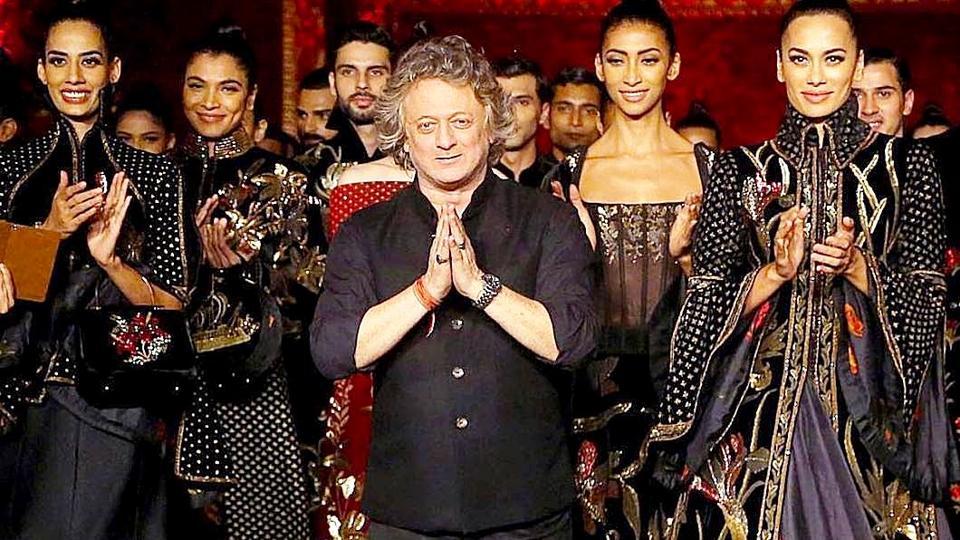
Rohit Bal started his career with his brother Rajiv Bal in New Delhi in 1986 the Company Orchid Oversea Pvt.Ltd, and started his own first independent collection in 1990.[1]
Bal was also chosen by the Khadi Gram Udyog, the largest handloom textile operation in Panchkula, to work with them. Bal won the ‘Designer of the Year’ award at the Indian Fashion Awards in 2006. He has also won ‘Designer of the Year’ at the Kingfisher Fashion Achievement Awards in 2001.[1] He was awarded as the Lakme Grand Finale Designer for 2012.[2]
Bal opened a flagship store in Delhi, as well as stores in Mumbai, Bangalore, Ahmedabad, Kolkata and Chennai. Bal has also ventured into designing jewellery.[3] He is best known for his use of lotus and peacock motifs. He frequently uses rich fabrics like velvet, brocade and his designs are elaborate, inspired by Indian grandeur and royalty.
Kumar began her fashion business in Kolkata, using two small tables and hand-block printing techniques. Beginning with bridal wear and evening clothes in the 1960s and 70s, she eventually moved into the international market in the subsequent two decades.[2] As well as shops in India, Kumar’s company has also opened branches in Paris, London and New York. The London branch closed after three years, in 1999. Her company’s annual turnover at the time was the highest of any Indian fashion outlet, estimated at around ₹10 billion.[3][4] In 2002 she launched the “Label” line in partnership with her son Amrish.[5] In 2013 she was given the Padma Shri award by the Government of India.[6] Kumar discusses her career at length in a recent interview for the Creating Emerging Markets project at the Harvard Business School, beginning with how she first broke into the Paris and New York fashion houses and department stores in the 1970s.[7][8][9]
Sabyasachi Mukherjee comes from a middle class Bengali family of Kolkata. His mother, Sondhya Mukherjee worked at Government Art College, and was deeply into handicrafts. His father, Sukumar Mukherjee lost his job when Sabyasachi was just 15 years old.[4] Sabyasachi’s sister Shingini Mukherjee (Payal), who is 7 years younger than him, manages the business of the label.[5]
Mukherjee wanted to study at NIFT. His parents disagreed, so Sabyasachi sold his books to pay for the admission form and passed the exam. After his graduation, he opened a workshop, and started his career from there.[6]
Career
Models walk for SabyaSachi Couture.
During the summer of 1999, Sabyasachi Mukerjee graduated from the National Institute of Fashion Technology India. Four months later, he started his eponymous label which began with a workforce of three people. In 2001, he won the Femina British Council’s most outstanding young Designer of India award, which took him to London for an internship with Georgina von Etzdorf, an eclectic designer based in Salisbury. Returning home with ideas, Sabyasachi started retailing at all major stores in India.
In 2002, Sabyasachi Mukerjee participated at the India Fashion Week which got positive feedbacks from the press. During the spring of 2003, he made his first international runway, with the “Grand Winner Award” at the Mercedes Benz New Asia Fashion week in Singapore, which paved his way to a workshop in Paris by Jean Paul Gaultier and Azzedine Alaia. In his collection “Kora” at the Lakme Fashion Week 2003, he used unbleached and hand woven fabrics with Kantha and other hand embroideries.
In 2004, Sabyasachi took a step ahead with Kuala Lumpur Fashion Week and The Miami Fashion Week[7] with a bohemian take on Indian textiles and his collection was called “The Frog Princess”. His significant achievements included his coveted showing in Browns earning him a retail place at the tiny London store voted by Vogue as the best shopping destination in the world, thereby establishing himself as one of the most promising young designers for years to come.
In 2005, his spring-summer collection, “The Nair Sisters” was inspired by hand block printing, embroideries, bagru prints and the extensive use of cotton and other hand woven fabrics. The collection was sold at Browns & Selfridges in London. He was requested to showcase his collections at the prestigious Oxford University annual black tie charity dinner fashion show.
2006, Sabyasachi’s debut Spring Summer collection’07 at New York Fashion Week earned him critical acclaim and his label started selling world-wide. The essence of this collection was based on folklore, glamour, simplicity, modern architecture and intricate detailing. There was a marked influence of paintings from the seventeenth and eighteenth century like Brueghel, Claude Monet and others. He used dark jeweled colors with muted shades accentuated with subtle texturing and indigenous embroidery. He is the only Indian designer to be a part of all three leading fashion weeks: New York, Milan and London. Sabyasachi believes that the unique positioning of Indian designers is due to the exclusivity of his homeland with its rich history and culture. He believes that Indian designers bring a flavor to the west that is no longer perceived as only exotic but also a rich blend of individuality and sensitivity.
2007, Sabyasachi participated at the New York and at the London Fashion Weeks plus Bridal Asia 2007, Lakme India Fashion Week and the Vogue Launch event in India. His “Sanctuary” collection showcased at Lakme Fashion Week Fall Winter 08 received positive reviews from the fashion editor of the New York Times, Suzy Menkes.[8]
Sabyasachi closed the third edition of PCJ Delhi Couture Week (8–12 August 2012) with his New Moon collection inspired by the flavours of five cities of the world- straitjacket discipline of New York, the nostalgia of the British Raj in Kolkata, the subversive decadence of Berlin, the romanticism of Paris and bohemian flair of Barcelona. Bollywood star Sridevi was the showstopper & walked the ramp for the designer in a sari.[9][10] The designer is showcasing this collection in UAE as well.[11] Sabyasachi launched in 2008 a line of jewelry exclusively designed by himself, in association with the GAJA brand. The collection was showcased at the Vogue Wedding Show 2016.[12] He launched his exclusive menswear collection featuring Sherwanis, Kurtas and headgear at the Lakme Fashion Week Spring Summer 09 Grand Finale show. He also started a kids wear line under the label Chota Sabhya.
In 2012, the designer styled a calendar for which Bollywood actress Neha Dhupia dressed up as famous painter Frida Kahlo,[13] who has been the designer’s inspiration for the Grand Finale at WIFW Autumn-Winter 2011 where the models walked the ramp wearing Frida Kahlo-esque rose headbands and wire-rimmed glasses.[14]
Sabyasachi Mukherjee’s Autumn Winter 2015 collection at Amazon India Couture Week (AICW) was a collaboration with French luxury footwear and fashion designer Christian Louboutin. 80 pairs of shoes, both for men and women, all embroidered with the quintessential Sabyasachi embroidery and embellished with hand-placed sequins, were created for the show. Louboutin also modified his signature Victoria heel for the collection, to be embroidered with the signature Sabyasachi embroidery using acid dyed burnt zardozi and vintage Parsi gara.
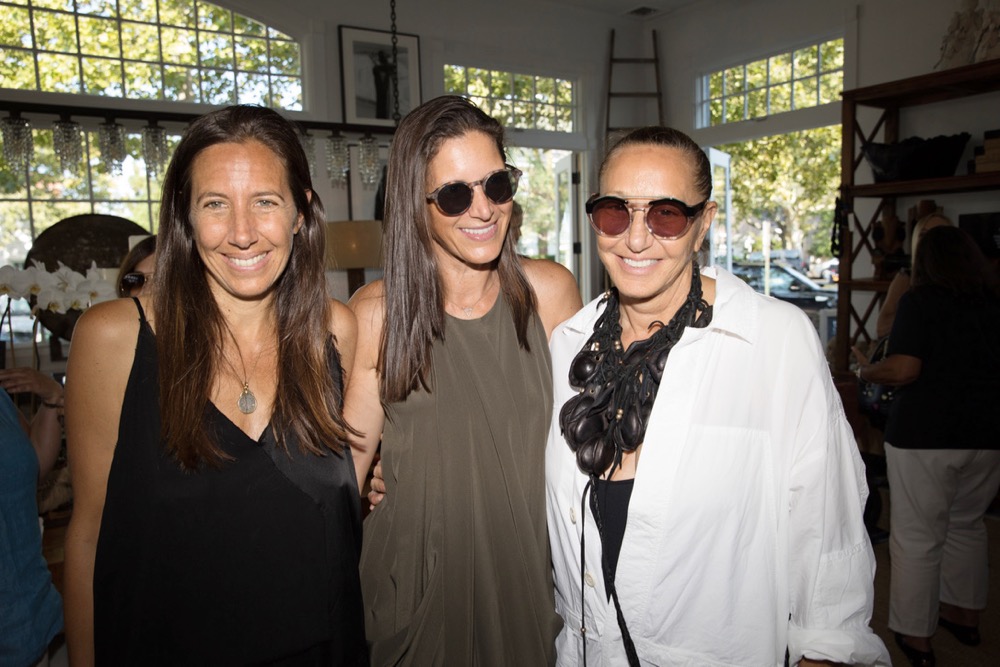
Gabby Karan de Felice, Gally Mayer, and Donna Karan attend an ARF volunteer appreciation party at Urban Zen x Tutto il Giorno on August 10, 2018 in Sag Harbor, New York.
Donna Karan (born Donna Ivy Faske; October 2, 1948), also known as “DK”, is an American fashion designer and the creator of the Donna Karan New York and DKNY clothing labels.
Early life
Karan was born Donna Ivy Faske to mother Helen (“Queenie”) and father Gabby Faske in the Forest Hills neighborhood of the Borough of Queens, New York City. Her family is Jewish.[1][2] Karan’s mother had been a model and had also worked in designer Chester Weinberg’s showroom. Her father was a tailor and haberdasher who died when Donna was three years old.
After leaving college, Karan worked for Anne Klein,[9] eventually becoming head of the Anne Klein design-team, where she remained until 1985, when she launched her Donna Karan label.
Karan began her career as an assistant designer with Anne Klein in the late 1960s, where she was promoted to associate designer in 1971. As Klein’s assistant, Karan was a participant in The Battle of Versailles Fashion Show on November 28, 1973. When Klein herself died in 1974, Takihyo Corporation of Japan became the new owner and Karan, together with her former classmate and friend Louis Dell’Ollio, became head designer of the house. In 1984, Karan left Anne Klein and, together with her then husband Stephan Weiss and Takihyo Corporation, started her own business “to design modern clothes for modern people”. She showed her first women’s clothing collection in 1985.[10]
Karan became well known for her ‘Essentials’ line, initially offering seven easy pieces centered around the bodysuit which could all be mixed and matched, and created a fully integrated wardrobe with her First Collection in 1985. Karan always insisted that she would design only clothes like jersey dresses and opaque Lycra tights that she would wear herself.[10]
In 1988, Karan, nicknamed The Queen Of Seventh Avenue,[11] extended her women’s ‘Donna Karan New York’ line by creating a less expensive clothing line for younger women, called DKNY. Two years later, she created DKNY Jeans, a denim-inspired collection. DKNY for men was launched in 1992, one year after the ‘Signature’ line for men had been presented. [12] In 1992, Karan also released her “cold shoulder” dress, a jersey long-sleeved dress which featured deep cutouts at the shoulders to reveal the skin beneath. [13]
Karan left her CEO position in 1997, but continued as chairwoman and designer for the Donna Karan line. After 2002, Karan’s designer contributions became less and less.[14] In August 2008, Karan relaunched her discontinued fragrance lines from the 1990s.[citation needed]
In 2015, Donna Karan announced that she would be stepping down as head of her eponymous company to focus on her lifestyle brand, Urban Zen, established by Karan in 2007.[15][16]
Awards
Karan won the Coty American Fashion Critics’ Award in 1977 and once again in 1982 (together with Louis Dell’Ollio for Anne Klein). She was inducted into the Coty Hall Of Fame in 1984.[17] The Council of Fashion Designers of America (CFDA) named her Menswear Designer of the Year 1992 and Womenswear Designer of the Year 1990 and 1996. She was a nominee for the latter again in 2003 and was presented with the Lifetime Achievement Award by the CFDA in 2004. She won special CFDA awards in 1985, 1986 and 1987
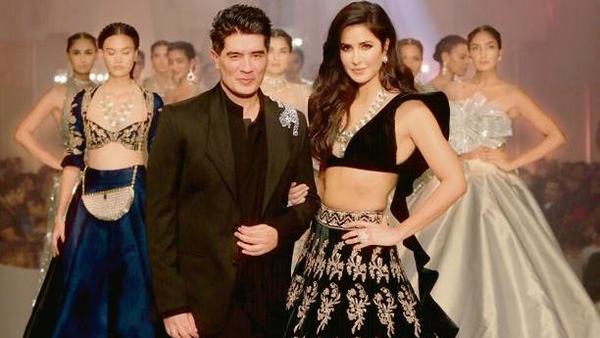
He received appreciation for his glamorous ensembles using traditional colours, craftsmanship, textures and embroideries presented at his first runway show in November 1999.[6] In 2005, he launched his couture label Manish Malhotra which offers bridal, couture, diffusion and men’s wear collections and retails at two stores in Mumbai and New Delhi. The label also retails at multi-brand boutiques across India and in Dubai.[7]
Malhotra has been reported to have been inspired by Indian craftsmanship and promotes regional handicrafts and workmanship from rural India through his association with the ‘Mijwan Welfare Society’– an NGO founded by Late Kaifi Azmi and headed by Shabana Azmi and Namrata Goyal.[8] In March 2017, the Philadelphia Museum of Art featured outfits from the Manish Malhotra 2013 couture collection – Thread of Emotion, in an ongoing retrospective spotlighting the Phulkari technique at their Joan Spain Gallery.
First Shows
London
Malhotra has made contributions to the India’s largest education NGO, Pratham,[10] once in 2013 and then in 2016. Manish Malhotra celebrated 100 years of Indian Cinema at the ARTiculate the Pratham Ball 2013, at London and raised 3,00,000 pounds for the Indian Education Charity.[11] His collection was inspired by the three main eras of the Indian Cinema, spanning from 1913 to 2013. It took the audience through the black and white era of “Mughal-E-Azam” and “Awara”. Also, actors Bipasha Basu and Esha Gupta who were already in London shooting for their film, Humshakals; walked the ramp for Malhotra.[citation needed]
Houston
Again on 23 April 2016, at the Pratham’s Annual Gala, held at Hilton America’s, Manish Malhotra raised $1.8 million to eradicate illiteracy in India.[12] His collection ‘The Regal Threads’, which emphasized the use of Indian heritage weaves from Benares and Gujarat, India; was showcased at the event.
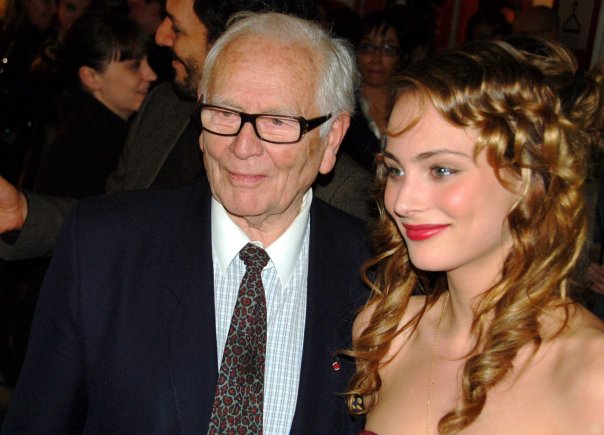
Pierre Cardin born Pietro Cardin[a] on 2 July 1922)[1] is an Italian fashion designer naturalized French.[2][3] He is known for his avant-garde style and his Space Age designs. He prefers geometric shapes and motifs, often ignoring the female form. He advanced into unisex fashions, sometimes experimental, and not always practical. He founded his fashion house in 1950 and introduced the “bubble dress” in 1954.
Cardin was born in San Biagio di Callalta near Treviso. Cardin’s parents were wealthy landowners, but to escape fascism they left Italy and settled in France in 1924.[5] His father, a wealthy French wine merchant, wished him to study architecture, but from childhood he was interested in dressmaking.
Cardin was educated in central France. Beginning his career early, at age 14 he worked as a clothier’s apprentice, learning the basics of fashion design and construction. In 1939, he left home to work for a tailor in Vichy, where he began making suits for women. During World War II, he worked in the Red Cross, launching humanitarian interests that continue to this day.[7]
Cardin moved to Paris in 1945. There, he studied architecture and worked with the fashion house of Paquin after World War II. He worked with Elsa Schiaparelli until he became head of Christian Dior‘s tailleure atelier in 1947, but was denied work at Balenciaga.
Cardin founded his own house in 1950. His career was launched when he designed about 30 of the costumes for “the party of the century”, a masquerade ball at Palazzo Labia in Venice on 3 September 1951, hosted by the palazzo’s owner, Carlos de Beistegui. He began with haute couture in 1953. He was the first couturier to turn to Japan as a high fashion market when he travelled there in 1959. That same year, he was expelled from the Chambre Syndicale for launching a ready-to-wear collection for the Printemps department store as the first couturier in Paris, but was soon reinstated.
During the 1960s, Cardin began a practice that is now commonplace by creating the system of licences that he was to apply to fashion. A clothing collection launched around this period surprised all by displaying the designer’s logo on the garments for the first time.[7] As haute couture began to decline, ready-to-wear soared as well as Cardin’s designs. He was the first to combine the “mini” and the “maxi” skirts of the 1970s. He introduced a new hemline that had long pom-pom panels or fringe that swayed as the body moved.[5]
Beginning in the 1970s, Cardin set another new trend: “mod chic”. This trend holds true for form or for a combination of forms, which did not exist at the time. He was the first to combine extremely short and ankle length pieces. He made dresses with slits and batwing sleeves with dimensions, and mixed circular movement and gypsy skirts with structured tops. These creations allowed for the geometric shapes that captivated him to be contrasted, with both circular and straight lines. Cardin was an icon for starting this popular fashion movement of the early seventies.[8]
Inspired by space travel and exploration, Cardin visited NASA (National Aeronautics and Space Administration) in 1970, where he tried on the original space suit worn by the first human to set foot on the moon, Neil Armstrong. Cardin loved the space suit so much, he created his own design for NASA in 1970.
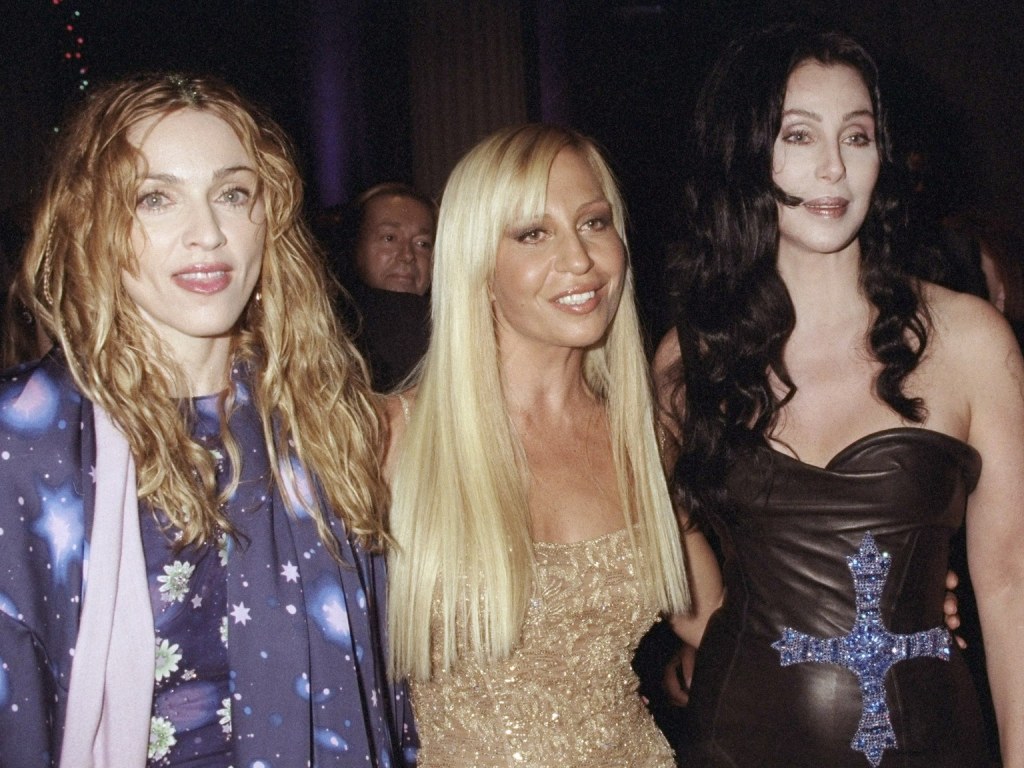
Donatella Versace was born in Reggio di Calabria, Southern Italy, the youngest of four children. Her father, Antonio, was a salesman and her mother, Francesca, was a dressmaker.[5] Her older sister, Tina, died at the age of 12 from an improperly treated tetanus infection.[6] Her brother, Santo Versace, inherited 30% of Versace upon Gianni’s death and her daughter, Allegra Versace, inherited 50%.
Fashion career
In the mid-1970s, Donatella followed her older brother, Gianni Versace, to pursue knitwear design in Florence, Italy. She had planned to work for her brother in the public relations department, but, according to her, was more valuable to him as a “muse and critic”.[9] Through her closeness to her brother’s enterprises, she entered the fashion world. In the 1980s, Gianni launched a perfume dedicated to her, Blonde, and gave her her own label, Versus, which Gianni formerly ran for her until his death.
On 18 July 1998, one year and three days after Gianni’s death, Donatella Versace mounted her first Haute couture show for the Versace Atelier at the Hôtel Ritz Paris. She built her runway over the hotel’s swimming pool, as her brother had done every season, though this time using sheer glass. She now oversees the production of a dozen collections each year.
Donatella has also played a major role in the design of the Palazzo Versace Dubai, the second Palazzo Versace hotel, which opened in November 2016.[12][13]
From October 2002 to January 2003, Gianni and Donatella’s best known Versace clothing was displayed in a special exhibit of the Victoria and Albert Museum in London.
Sandeep Khosla is a noted Indianfashion designer, who co-owns the label, Abu Jani-Sandeep Khosla.[1][2][3] He is best known for his ability to infuse Indian craftsmanship and textile heritage with European tailored silhouette.[4] His signature is to combine traditional aesthetics with modern design.
Of late, Khosla has taken on several projects in interior design. He has designed interiors for hotels (such as The Sofala, Goa),[7] restaurants (the Aish at the Park, Hyderabad),[8] resorts and homes, and has even begun to event design for Indian weddings.
Biography
Born in Kapurthala, in a Punjabi family, Khosla studied at The Doon School before joining his family’s leather and garment business.[9][10] He completed his studies with college in Jalandhar, thereafter he studied for a year at a leather institute in Chennai, but left to move to Delhi. Here he started working as a buyer for an export house and eventually opened a small boutique, Limelight. However soon he shifted to Mumbai, and started working with a film costume designer, Xerxes Bhathena. Incidentally, Abu Jani had also assisted Bhatena for while, soon they met and decided to work together.[11][12]
In 1986, they launched a boutique, Mata Hari. After their work was featured in a noted featured on the cover of the a noted Bombay magazine, they became one of the five designers to join Tarun Tahiliani for his multi-brand boutique Ensemble in 1987. Actress Dimple Kapadia became their first celebrity client, and in turn led to other noted clientele like Jaya Bachchan and Parmeshwar Godrej.[12][13]
Their furniture line debuted at Bajaj Gallery in Mumbai in 1993.[12] In 2012, the label Abhu Jani-Sandeep Khosla completed 25 years in fashion industry with a fashion show.

 Kavya
Kavya 